Your game kicks you to the menu. The call freezes. A page hangs on loading. By the time you look at the router, every light is green and everything works again. That’s what makes drops so hard to fix: the fault is gone before you can see it. This guide starts with a log instead of a reboot, because the shape of the drops tells you which box to blame, and most of the usual advice skips that step.
Log the drops before you touch anything
Every guide on this topic opens with the same list. Restart the router, update the firmware, check the cables, change the channel. None of those steps are wrong. They’re unordered. You can spend a weekend on them and never learn whether the problem was in your house at all.
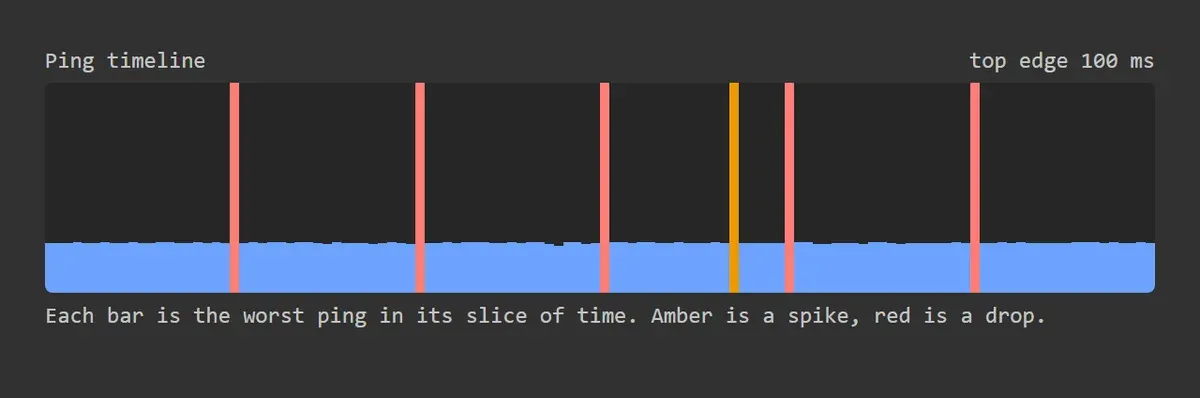
So catch the fault on record first. Open the internet stability test on the device that suffers, pick a 30 or 60 minute window, and start it at the hour the connection usually acts up. It pings this site’s edge once a second from a background tab and writes down every answer. Go play, take the call, do whatever normally breaks. When the window ends you get uptime, a drop count, the length of the longest outage, and a timeline that shows exactly when the line went quiet.
A speed test cannot do this job. It measures how much data moves in about ten seconds, and a line can pass that with a perfect score while going silent for two seconds every few minutes. Two seconds is nothing to a download. It’s enough to end a match or freeze a call.
One run at noon proves nothing about a 9 pm problem. If the first window comes back clean, run it again at the bad hour, and once more the next day.
Read the shape of the drops
The verdict tells you how bad the run was. The timeline tells you what kind of fault you have, and that is the part that saves you a weekend. Four shapes cover almost every case.
Drops on a clock. Red bars at a regular spacing: every 30 minutes, every hour, every few minutes on the dot. Cables and interference don’t keep time. A timer does. The usual timers are a router renewing its address lease from the provider and failing to do it cleanly, a router that rescans Wi-Fi channels on a schedule and resets its radio each time, and a laptop adapter that goes to sleep after a fixed idle period. Look for the interval in your router’s settings before you look anywhere else.
Short random blips. Many drops of one to three seconds, scattered with no pattern, and a jitter figure that stays high even between them. This is what a weak or crowded wireless link looks like. The link is renegotiating, or the device is hopping between bands, or a neighbor’s router is talking over yours. It’s almost always fixable at home, and it almost always vanishes on a cable.
Long outages, a few a day. One or two red stretches of ten seconds to a few minutes, with clean line on either side. The modem or the fiber terminal lost its link to the provider and had to register again. On cable that shows up in the modem’s event log as T3 and T4 timeouts. On DSL it is a line retrain. This shape is a line or signal problem far more often than a router problem, and a reboot never fixes it for long.
Spikes without drops. The verdict says Spiky, uptime is 100 percent, and amber bars cluster at the hours the household is busiest. Nothing is dropping. Your ping is climbing under load, which is congestion, usually bufferbloat in your own router. That is a different fix with its own guide. And if a shooter still stutters on a flat, clean log, run the packet loss test: a lost packet that gets quietly resent never shows up as a drop here.
One more clue sits outside the log. When a drop hits, look at the Wi-Fi icon. If it disappears or shows no network, the wireless link itself went down, and the fault is between your device and the router. If the icon stays connected but nothing loads, your link to the router is fine and the router lost its way to the internet. Those are two different problems that most fix lists roll into one.
Find the box that is failing
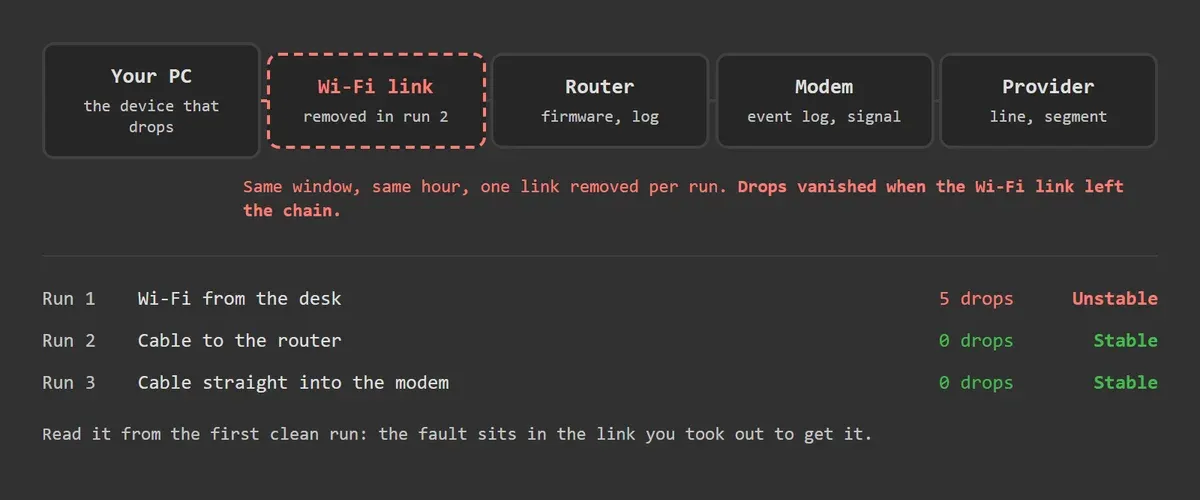
Your connection is a chain: device, wireless link or cable, router, modem or fiber terminal, then the provider’s line. The log says a link is broken. Removing links one at a time says which one. Run the same window at the same hour after each change.
- Second device. Run the monitor on a phone or another laptop at the same time, on the same Wi-Fi. If only one device drops, the chain is fine and that device is the problem. Skip to the device section below.
- Cable to the router. Plug the suffering device into the router with an Ethernet cable and run the window again. If the drops vanish, the fault is the wireless link. If they stay, the wireless link was never the problem, whatever the Wi-Fi guides say.
- Cable straight into the modem. If your modem and router are separate boxes, bypass the router: plug the computer into the modem directly, power cycle the modem so it hands your computer an address, and run the window. Drops that vanish here were the router’s. Drops that stay belong to the modem, the wiring to it, or the provider.
- Provider. With drops still present on a cable straight into the modem, you have gone as far as you can from your side. What you have now is a log the provider cannot wave away. The last section covers how to hand it over.
Most people run this ladder in reverse. They call the provider first, get told to reboot, and never try the cable. Running it forward takes two or three windows and ends the guessing.
Only one device drops
When the phone stays online and the PC keeps dropping, the router is innocent. Three things on the device cause most of it.
Adapter power saving. Windows is allowed to switch the network adapter off to save power, and on some laptops it does that in the middle of a session. Open Device Manager, expand Network adapters, open the properties of your Wi-Fi or Ethernet adapter, go to the Power Management tab, and clear the box that lets the computer turn the device off. This one checkbox ends a large share of the “every few minutes” drops on laptops.
The driver. If the drops started right after a Windows update, roll the network driver back from the Driver tab of the same properties window. If they didn’t, install the latest driver from the laptop or motherboard maker’s site rather than the one Windows Update picked. MediaTek and Realtek adapters in budget laptops come up again and again in these threads.
Network hopping. A device that knows several networks will jump to a neighbor’s guest network or a phone hotspot the moment your signal dips, then jump back a few seconds later. In Settings, under Network and internet, Wi-Fi, Manage known networks, turn off automatic connection on every network except your own. On a router that uses one name for both bands, switch off Smart Connect or band steering for a day and see whether the device stops hopping.
If none of that holds, borrow a USB network adapter and run the same window on it. Drops that vanish on a 15 dollar dongle prove the built-in adapter is failing. That is how one long forum thread on this exact symptom finally ended, after weeks of swapping routers and cables: a diagnostic on the onboard chip failed its loopback test, and an external adapter fixed it for good.
The drops vanish on a cable
Now the problem is the wireless link, and the fixes are about signal, not settings on the PC.
Move to 5 GHz. The 2.4 GHz band is shared with microwaves, Bluetooth, cordless phones and every neighbor’s router. It reaches further and it is far noisier. If your device and router both offer 5 GHz, connect to that band by name and keep it there.
Fix the channel. A router set to automatic channel selection sometimes rescans and switches mid-session, and every switch is a short drop. Pick a fixed channel. On 2.4 GHz that means 1, 6 or 11 and nothing in between. On 5 GHz pick one that a Wi-Fi analyzer app on your phone shows as empty around you, instead of guessing.
Move the router. Height and open air beat everything. A router in a cabinet, behind a TV or on the floor loses signal to metal and water. Put it high, in the open, near the middle of the home, and away from the microwave.
Update the firmware, then stop. One firmware update is worth doing, since stability bugs in a router’s wireless driver are real and vendors do fix them. Repeated factory resets are not. If the router is more than five or six years old and still drops after all of this, its radio is tired, and a replacement or a mesh node with a wired backhaul is the honest answer.
The cable drops too
Now the fault is the router, the modem, the wiring, or the provider. Work outward.
Reboot as a test, not a fix. Power cycle the router and watch the log for a day. If the drops stop and then creep back over a day or two, the router is running out of memory or overheating. That’s a hardware verdict, and firmware rarely rescues it. Replace it.
Read the router log. Every router keeps a system log, usually under Advanced or System. Look for lines stamped at the times of your drops: WAN down, DHCP renew, PPPoE timeout, link down. A WAN line at every drop means the router lost its way to the modem, and the fault is that cable, the modem, or the provider. No matching lines at all means the router never noticed anything, which points back at the wireless side after all.
Then the modem. A cable modem has an event log and a signal page, usually at 192.168.100.1. In the event log, look for T3 and T4 timeouts stamped at the times you dropped. One or two a day is background noise. A dozen a day, or a cluster around your outages, means the modem keeps losing contact with the provider’s equipment, and a reboot cannot fix that. On the signal page, downstream power between about minus 7 and plus 7 dBmV, downstream SNR above 33 dB, and upstream power under about 50 dBmV is the range technicians treat as healthy. Upstream power creeping toward 50 and past it usually means a bad splitter, a corroded connector, or a long or damaged coax run, and the modem is shouting to be heard.
Before you call anyone, do the cheap checks on that coax. Hand tighten the F connector on the modem and at the wall, pull out any splitter you do not need, and swap a coax cable that has been kinked or run outdoors. On DSL, replace the phone cord with a short one, plug straight into the main jack, and make sure every other phone on the line has a filter. On fiber, check that the terminal’s light is steady and that nobody has bent the fiber sharply behind a desk.
Weather and time of day. Drops that come with rain point to an outdoor connector or a damaged drop line, which is the provider’s. Drops that come every evening at the same hour on a cable line point to a crowded neighborhood segment, also the provider’s. Neither is fixable from inside the house, but both get fixed much faster once you can show when they happen.
Make the provider fix it
Support’s first move is to have you reboot and then tell you the line looks fine. A log changes that conversation. Bring three things.
Two or three share links from the stability monitor, each a 30 or 60 minute run on a cable, from different days, at the bad hour. Each link carries uptime, the drop count, the longest outage and your ping, and support can open it without an account. One run gets waved off as a fluke. Three from three evenings do not.
The modem’s event log lines with timestamps that line up with those runs. T3 and T4 timeouts at the moment of an outage are the words their technicians use. Say them.
A short summary you can read out: cabled straight into the modem, drops of 20 to 40 seconds, three to five times per evening between 8 and 11, for the past two weeks, logs attached. Ask for a signal check at the tap and a technician visit. If they offer a new modem, take it, then run the same window again. An outage that survives a new modem is on their side of the wall, and now you have shown it.
Prove the fix worked
Whatever you changed, close the loop the same way you opened it. Run the same window, at the same hour, on the same device, and compare. Stable with 100 percent uptime and a flat timeline is the goal. A run that moves from Unstable to Brief drops is progress, not a fix. Keep the share links. When the drops come back in six months, you will know in one evening whether this is the same fault or a new one.